CVE-2025-23087: The Universal Node.js Vulnerability You Can't Ignore
On this page
🧠 What Is CVE-2025-23087?
CVE-2025-23087 is a high-severity vulnerability impacting all End-of-Life (EOL) Node.js versions, up to and including v17.9.1. It isn't a single exploit, but rather a composite vulnerability stemming from the use of outdated and unmaintained third-party dependencies in the Node.js core.
🔍 Technical Details
- CWE-1104 – Use of Unmaintained Third-Party Components
- CVSS v3.1 Score – 8.8 (High)
- Attack Vector – Network
- Privileges Required – Low
- User Interaction – None
- Impact – High on Confidentiality, Integrity, and Availability
The vulnerability arises due to insecure components like:
- OpenSSL v1.x – Known for multiple RCE and DoS vulnerabilities
- llhttp – May enable HTTP request smuggling
- nghttp2, zlib – Both contain known flaws that are unpatched in EOL Node.js versions
💣 Proof of Concept (PoC)
Although a direct PoC for CVE-2025-23087 is not publicly released as a single exploit, researchers have demonstrated the use of chained exploits through:
- Exploiting a vulnerability in OpenSSL v1.1.1 to crash TLS connections.
- Using outdated
llhttpto bypass request parsing safeguards.
- Triggering denial-of-service via malformed payloads.
Here’s an example snippet that can crash an EOL Node.js server still using vulnerable modules:
`**jsCopyEditconst https = require('https');
const options = {
  hostname: 'target-nodejs-app.com',
  port: 443,
  method: 'GET',
  path: '/',
  headers: {
    'Transfer-Encoding': 'chunked',
    'Content-Length': '1000000000' // Triggers vulnerability in parsing
  }
};
https.request(options).end();**`
> ❗ Warning: Use only in authorized environments for research or testing.
⚠️ Risks of Using EOL Node.js Versions
- Zero patch coverage – Even if a critical bug is found, no official fix is released
- Legal compliance issues – May violate policies like ISO 27001 or PCI-DSS
- Lack of dependency updates – Exposes applications to RCE and DoS attacks
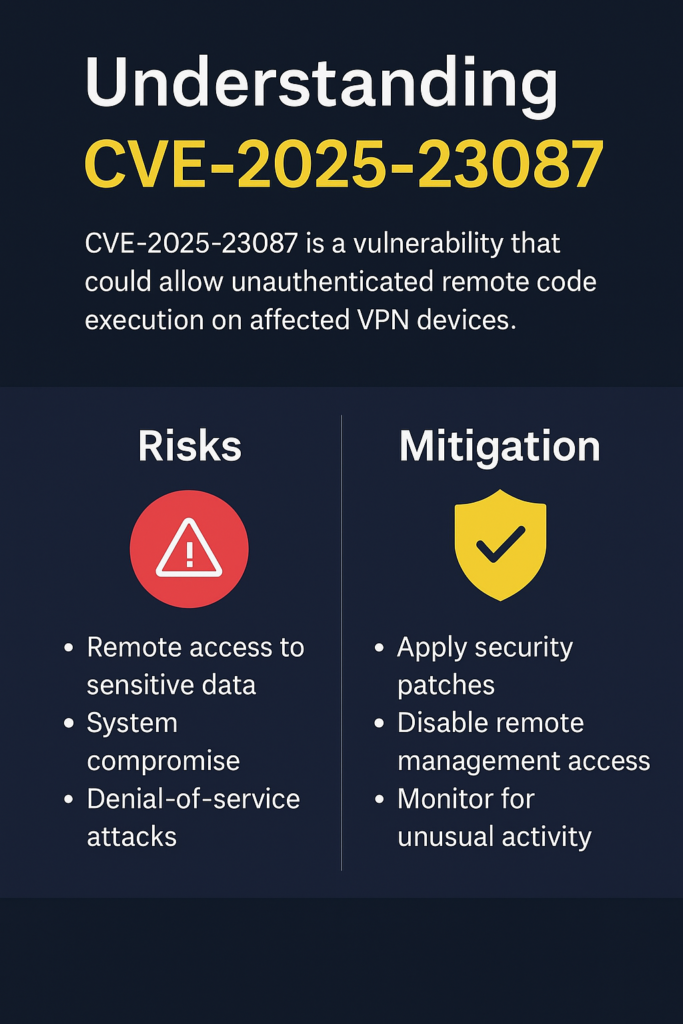
> 📎 OpenSSL Vulnerabilities Overview
🛡️ How to Mitigate CVE-2025-23087
✅ 1. Upgrade to Active LTS Versions
Update to Node.js v18.x or v20.x, both of which are actively supported.
✅ 2. Use Extended Support Options
Organizations like HeroDevs offer Never-Ending Support (NES) for critical applications that can’t upgrade immediately.
✅ 3. Audit Your Stack
Run tools like:
npm audit
snyk test
node --trace-warnings
These help flag known vulnerabilities in dependencies.
🔄 Internal HackerVault Links
🧭 Final Thoughts
CVE-2025-23087 isn’t just about one bug—it’s about the invisible danger of running outdated core systems. If you're still using unsupported Node.js versions, you're wide open to attack. This CVE serves as a wake-up call to modernize, patch, or seek commercial support—before someone else finds the hole for you.